Search The Blog

Monday, March 31, 2014

03.31 - Orpheus Myth and Revisions

Our class today was focused on completing the work we began last week with the story of Orpheus and Eurydice. This included some practice work with the use of the hero's journey note sheet and the Orpheus and Eurydice found poem.

Once people had completed those assignments, everyone was to focus on revising or completing their creation story essay and/or their creation story illustration. I also returned creation story archetype note sheets that could be revised and I printed out grade report sheets so that people could also work on completing any third quarter assignments that had not yet been completed.

Tomorrow we will pick back up our work with the hero's journey by looking at the model in a slightly longer story. Then we will fully immerse ourselves in some classic myths once more!

Handouts/Helpful Papers:
Creation Story Essay
Creation Story Essay Rubric    


Creation Stories:
Aztec 
 
Homework:
 
Complete missing work and revise any assignment that scored below a 92.
 
Keep up to date on your grades through Pinnacle:
In school: 192.168.8.7/Pinnacle/PIV
Outside of school: http://pinweb.lisbonschoolsme.org/pinnacle/pin


Friday, March 28, 2014

03.28 - Hero's Journey Discussion of Orpheus Myth

We did not have the juniors in our class today due to science testing being done school-wide.

In class, we reviewed and discussed responses for how the hero's journey model can be applied to the Orpheus myth that we read in class. Our discussion mainly focused on different possible connections, the order in which they occurred, and how the story was affected if one event were given different labels (i.e. labeling an event as being "approach to the abyss" or "ordeal").

Everyone had the remaining time in class to work on their Orpheus and Eurydice found poem or other quarter 3 work since grades close today.

Handouts:
Homework:
If you did not do so in class, complete the hero's journey notesheet for the Orpheus and Eurydice myth.
Begin selecting words and phrases for the Orpheus and Eurydice found poem.
Complete missing work and revise any assignment that scored below a 92.
Keep up to date on your grades through Pinnacle:
In school: 192.168.8.7/Pinnacle/PIV
Outside of school: http://pinweb.lisbonschoolsme.org/pinnacle/pin

Thursday, March 27, 2014

03.27 - Orpheus and Eurydice

We started class today by sharing the hero's journey found poems that people created last night for homework. This lead us into a review of the stages of the hero's journey and the different archetypal individuals that the hero experiences throughout the journey (the mentor, shadow, ally, trickster, etc).

Next, we read a classic myth from Greek mythology about Orpheus and Eurydice. In reading this myth, we were looking for the stages of the hero's journey and the archetypal figures that the hero (Orpheus) encounters on his journey. I read the story aloud to the class so that everyone could underline pieces of the text or take notes as we read.

Upon completing the story, everyone used the hero's journey note sheet to map out the elements of the story.

In the last ten minutes of class, we looked at making a found poem based on this story. One of the elements we addressed with found poems was that while the words cannot be altered from the text their arrangement on the page can be manipulated to add meaning in the overall poem. In class, I used the poem "Down..." by Jim Morrison (of The Doors) as a simple illustration of how word positioning on the page is used to control the reader's experience and understanding of the words on the page. This is a tool people can use to their advantage in writing found poems.

Click Image to Enlarge
In this poem, the word "down" is repeated and staggered on a different line leading to "deep" and "below." The reader's eyes have to descend, as though down stairs, leading to where the main imagery of the poem has been buried. Reading the words of the poem becomes a journey as it would be to travel to this place where "secret fires glow." This shows one way in which meaning can be added to a poem without adding extra description or words.


Handouts:


Homework:

If you did not do so in class, complete the hero's journey notesheet for the Orpheus and Eurydice myth.

Begin selecting words and phrases for the Orpheus and Eurydice found poem.

Complete missing work and revise any assignment that scored below a 92.
Keep up to date on your grades through Pinnacle:
In school: 192.168.8.7/Pinnacle/PIV
Outside of school: http://pinweb.lisbonschoolsme.org/pinnacle/pin

Wednesday, March 26, 2014

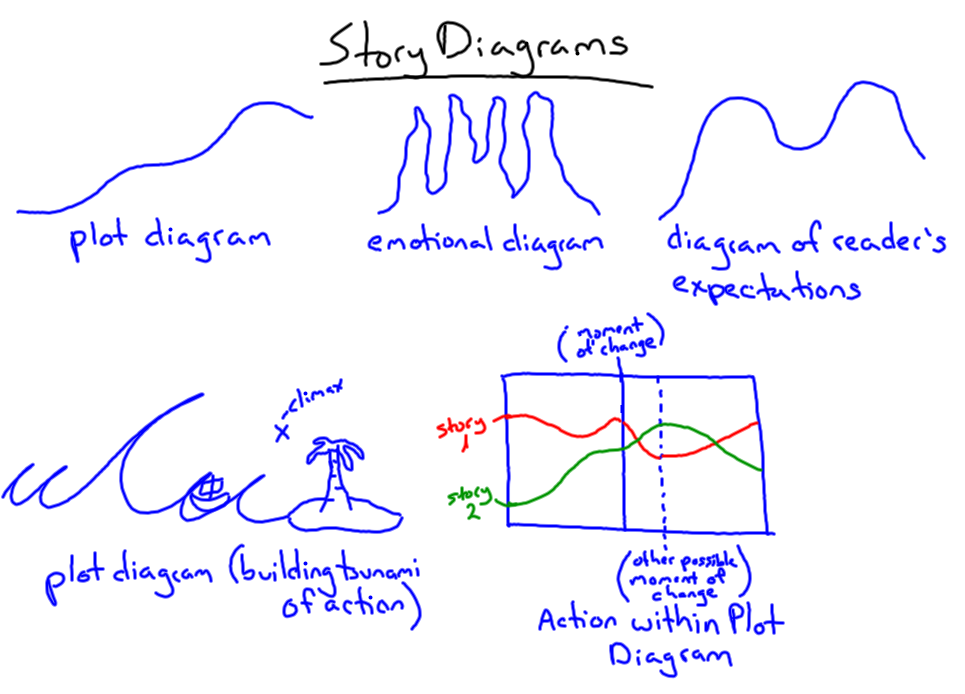
Story Diagrams

These are the story diagrams that people created and described in class.

Click to Enlarge


This is the basic outline of Campbell's plot diagram with which we will be working in class.


03.26 - Hero's Cycle

For today's class we were becoming familiar with Joseph Campbell's plot diagram of the hero's journey (which is also often referred to as the "monomyth" or "the hero with 1,000 faces"). We read an introduction to the hero's journey and talked about what this diagram looks like when applied to familiar stories (in class we used Disney movies like "The Lion King" and stories like "Harry Potter" and "Lord of the Rings").

Next, I introduced everyone to a poem style called found poetry where a poem is created by selecting and arranging words and phrases from a source text to make a poem. We looked at several examples of found poems created using the sheet that explained found poems (see below).

We will look at applying the hero's journey model to a classic myth in our next class.

Handouts:
Introduction to the Hero's Journey
Found Poem: How To

Found poem examples (made from the "Found Poem: How To" sheet):

Click Image to Enlarge

(This was a tongue-in-cheek found poem) - Click Image to Enlarge

Homework:

Write a found poem using the hero's journey introduction text from today in class.
You can challenge yourself in doing this at different levels:

Master Hero: Create a found poem exploring the question "Who is the hero with 1,000 faces?"
Hero: Create a found poem exploring the idea "What is the hero's journey"
Everyman Hero: Create a free-form found poem from the text.

Complete missing work and revise any assignment that scored below a 92.
 
Keep up to date on your grades through Pinnacle:
In school: 192.168.8.7/Pinnacle/PIV
Outside of school: http://pinweb.lisbonschoolsme.org/pinnacle/pin

Tuesday, March 25, 2014

03.25 - Intro to the Hero's Journey

At the beginning of class today, everyone had five minutes to do the following:

1 - Write down (brainstorm) as many story elements as you can.
2 - Diagram out the shape that you feel most stories take. In this diagram, indicate where each of the story elements you brainstormed would typically come up.

Next, we shared out the elements and diagrams that people came up with and took time to discuss similarities and differences amongst them. Next, we read a piece that introduces Joseph Campbell's theory of the hero's journey/monomyth/story with 1,000 faces. We read this piece together, pausing to discuss it at appropriate times.

When we finished the reading we discussed how this is another, very well informed, very well thought out, way to diagram stories. Everyone took a moment to map the story elements they had brainstormed at the beginning of class on to Campbell's model (see the last sheets of the reading).

We discussed what various stages of the hero's journey look like in familiar stories (like The Lion King). We will continue working with the hero's journey tomorrow.

Handouts:
Hero's Journey Introduction


Homework:

Choose a story you are familiar with and identify the stages of the hero's journey as they appear in the story. This may be an actual journey or an inner journey. Record your connections on the sheet included with the reading.

Complete your creation story essay and illustration if you have not done so already.

Complete missing work and revise any assignment that scored below a 92.
 
Keep up to date on your grades through Pinnacle:
In school: 192.168.8.7/Pinnacle/PIV
Outside of school: http://pinweb.lisbonschoolsme.org/pinnacle/pin
Monday, March 24, 2014

03.24 - Revision and Creation Story Essays

For class today, I returned work that had been submitted last week and graded over the weekend along with updated grade report sheets. Everyone had the period to revise work, complete their creation story illustration, or work on their creation story essay. Creation story essays should be handed in by Friday.

Today was the last day that everyone will have class time to work on their creation story illustration or essay. Further work on these assignments should be done for homework. I am available from 2-3:30 p.m. after school on Monday, Tuesday, Wednesday, and Friday if anyone needs help or needs to use the crayon/water color supplies. It is also possible for people to come in and work quietly while I have other classes (this needs to be done by appointment though as it depends on which period and what each class is doing).

Creation story illustration requirements:

1 - Illustrate a moment or idea from one of the creation stories that depicts one of the essential moments or ideas from that story.
2 - Include with your illustration a quote (a sentence or phrase) that adds to the meaning of the illustration.

Handouts:
Creation Story Essay
Creation Story Essay Rubric


Tomorrow we will begin working with stories that relate to the mono-myth/hero cycle.


Homework:

Complete your creation story essay and illustration if you did not do so today in class (see description/prompt and rubric above).


Complete missing work and revise any assignment that scored below a 92.
Keep up to date on your grades through Pinnacle:
In school: 192.168.8.7/Pinnacle/PIV
Outside of school: http://pinweb.lisbonschoolsme.org/pinnacle/pin